Autonomous Marine Systems: Evolution, Engineering Architecture, and Operational Benefits — A Review
Keywords:
Autonomous Marine Systems (AMS), Marine Engineering, Hull Design, Propulsion, Energy Systems, GNC, Sensor Integration, Subsea CommunicationAbstract
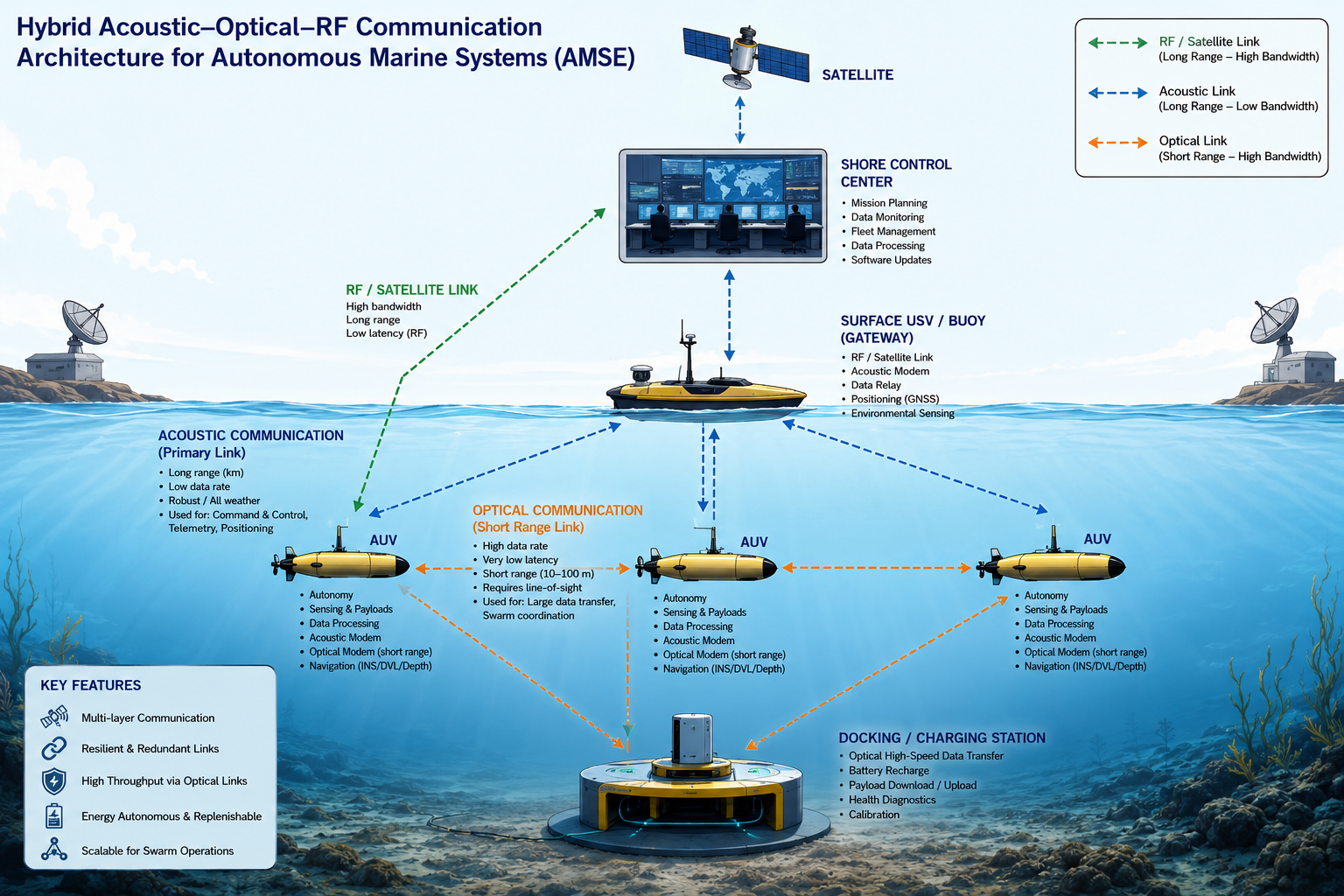
Autonomous Marine Systems (AMS) are evolving from specialized research platforms into practical engineering assets for ocean observation, hydrographic survey, subsea inspection, environmental monitoring, and maritime operations. This review examines the evolution and classification of autonomous underwater vehicles (AUVs), underwater gliders, unmanned surface vehicles (USVs), hybrid systems, and cooperative architectures from an engineering perspective. Particular attention is given to the coupled design of hull geometry, hydrodynamics, structural materials, propulsion, energy storage and harvesting, guidance-navigation-control, sensor and payload integration, and marine communication. The review evaluates how these engineering choices influence speed, endurance, depth capability, maneuverability, payload capacity, navigation accuracy, data quality, reliability, and operational cost. Representative platform classes including REMUS, HUGIN, Slocum, Seaglider, Spray, Saildrone, and Wave Glider are used to illustrate alternative design philosophies and mission trade-offs. The principal operational benefits of AMS include reduced personnel exposure, improved access to hazardous and remote environments, repeatable data collection, reduced dependence on support vessels, and increased spatial and temporal coverage. The paper argues that successful AMS development requires multidisciplinary systems engineering in which vehicle architecture, propulsion, energy, sensing, navigation, communication, and mission requirements are considered as a coupled design problem. This engineering perspective provides a foundation for understanding the persistent challenges and future technologies addressed in a companion review focused on resilience, autonomy, and lifecycle engineering.